Both Eldric Client and Controller support multiple backends. Mix local inference with cloud APIs across your infrastructure.
OpenAI-Compatible Streaming
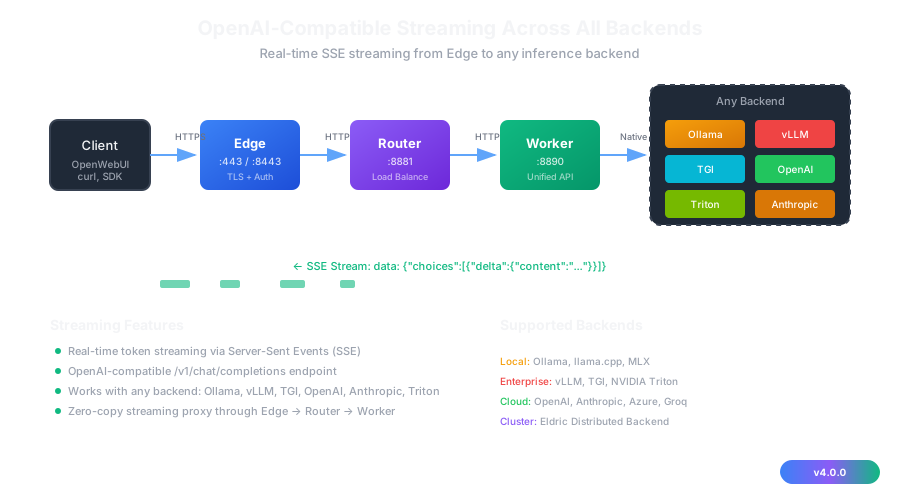
Universal SSE Streaming
All backends support real-time token streaming via Server-Sent Events (SSE). Use stream: true in your /v1/chat/completions request. The streaming flows seamlessly through Edge → Router → Worker → Backend.
Unified Backend Features
Streaming
- SSE (Server-Sent Events)
- Real-time token delivery
- OpenAI-compatible format
- Zero-copy proxy
Unified API
- /v1/chat/completions
- /v1/models
- /v1/embeddings
- Same API for all backends
Load Balancing
- Round-robin / Least connections
- AI-powered routing
- Automatic failover
- Health monitoring
Multi-Backend
- Mix local + cloud
- Fallback chains
- Per-model routing
- Hot backend switching
Local & Self-Hosted
Ollama
- Port: 11434
- REST API
- Auto model discovery
- Default backend
vLLM
- Port: 8000
- OpenAI-compatible
- PagedAttention
- High throughput
llama.cpp
- Port: 8080
- REST + WebSocket
- GGUF models
- CPU + GPU
HuggingFace TGI
- Port: 8080
- REST + gRPC
- Tensor parallelism
- Continuous batching
LocalAI
- Port: 8080
- OpenAI-compatible
- Multiple formats
- CPU optimized
ExLlamaV2
- Port: 5000
- REST API
- GPTQ/EXL2 quants
- Fast inference
LMDeploy
- Port: 23333
- OpenAI-compatible
- TurboMind engine
- Quantization
MLC LLM
- Port: 8080
- REST API
- Universal deploy
- WebGPU support
Enterprise & ML Platforms
NVIDIA Triton
- Port: 8000-8002
- REST + gRPC
- TensorRT optimization
- Multi-framework
NVIDIA NIM
- Port: 8000
- OpenAI-compatible
- Optimized containers
- Enterprise ready
TensorFlow Serving
- Port: 8501/8500
- REST + gRPC
- Model versioning
- Batch prediction
TorchServe
- Port: 8080/8081
- REST + gRPC
- PyTorch native
- Model archive
ONNX Runtime
- Port: 8001
- REST + gRPC
- Cross-platform
- Hardware agnostic
DeepSpeed-MII
- Port: 28080
- REST API
- ZeRO-Inference
- Low latency
BentoML
- Port: 3000
- REST + gRPC
- Model packaging
- Adaptive batching
Ray Serve
- Port: 8000
- REST API
- Auto-scaling
- Distributed
Cloud AI Services
AWS SageMaker
- HTTPS endpoint
- REST API
- Auto-scaling
- Multi-model
AWS Bedrock
- HTTPS endpoint
- REST API
- Foundation models
- Managed service
Azure ML
- HTTPS endpoint
- REST + SDK
- Managed compute
- MLflow integration
Azure OpenAI
- HTTPS endpoint
- OpenAI-compatible
- Enterprise security
- Regional deploy
Google Vertex AI
- HTTPS endpoint
- REST + gRPC
- TPU support
- Model Garden
Groq
- HTTPS API
- OpenAI-compatible
- LPU inference
- Ultra-fast
xAI (Grok)
- HTTPS API
- OpenAI-compatible
- Grok models
- Vision + Tools
Together AI
- HTTPS API
- OpenAI-compatible
- Open models
- Fine-tuning
Fireworks AI
- HTTPS API
- OpenAI-compatible
- Fast inference
- Function calling
Anyscale
- HTTPS API
- OpenAI-compatible
- Ray-based
- Scalable
Replicate
- HTTPS API
- REST API
- Model hosting
- Pay-per-use
Model Provider APIs
OpenAI
- HTTPS API
- REST API
- GPT-4, GPT-4o
- Assistants API
Anthropic
- HTTPS API
- REST API
- Claude models
- Tool use
Google Gemini
- HTTPS API
- REST API
- Gemini Pro/Ultra
- Multimodal
Mistral AI
- HTTPS API
- OpenAI-compatible
- Mistral/Mixtral
- Function calling
Cohere
- HTTPS API
- REST API
- Command models
- Embeddings + Rerank
AI21 Labs
- HTTPS API
- REST API
- Jurassic models
- Specialized tasks
Concept-Space Models
Unlike token-based LLMs, Meta LCM operates in semantic concept space—reasoning at a higher level of abstraction before generating text.
Meta LCM (Local)
- Port: 8000
- REST API
- SONAR encoder (200+ langs)
- Diffusion-based reasoning
- Concept ↔ Text conversion
Meta LCM Cloud
- HTTPS API
- OpenAI-compatible
- Managed infrastructure
- High availability
- Enterprise SLA
Specialized & Platform-Specific
MLX (Apple Silicon)
- Port: 8080
- REST API
- Metal acceleration
- Unified memory
KServe
- Port: 8080
- REST + gRPC
- Kubernetes native
- Serverless
Seldon Core
- Port: 9000
- REST + gRPC
- ML deployment
- A/B testing
OpenAI-Compatible
- Any port
- Custom endpoints
- API key auth
- Drop-in support
Backend by Use Case
| Use Case | Recommended Backends | Why |
|---|---|---|
| Development | Ollama, LocalAI, LMDeploy | Easy setup, free, local |
| Production API | vLLM, TGI, Triton, NIM | High throughput, batching, enterprise |
| Edge / IoT | llama.cpp, MLC LLM, ExLlamaV2 | CPU inference, small footprint, quantized |
| Apple Silicon | MLX, Ollama, MLC LLM | Metal acceleration, unified memory |
| Low Latency | Groq, xAI, Fireworks, DeepSpeed-MII | Optimized hardware, fast inference |
| Enterprise Cloud | Azure OpenAI, Bedrock, Vertex AI | Compliance, SLA, managed |
| Open Models | Together AI, Anyscale, Replicate | Llama, Mistral, open weights |
| Kubernetes | KServe, Seldon, Ray Serve | Cloud-native, auto-scaling |
Streaming & Feature Support
| Backend | Type | Streaming | Vision | Native Tools | XML Tools | Embeddings | |
|---|---|---|---|---|---|---|---|
| Ollama | Local | ✓ | ✓ | ✓ | ✓ | ✓ | ✓ |
| vLLM | Enterprise | ✓ | ✓ | ✓ | ✓ | ✓ | ✓ |
| TGI | Enterprise | ✓ | ✓ | — | ✓ | — | |
| NVIDIA Triton | Enterprise | ✓ | ✓ | — | ✓ | ✓ | |
| llama.cpp | Local | ✓ | ✓ | — | ✓ | ✓ | |
| MLX | Local (macOS) | ✓ | — | ✓ | — | — | |
| OpenAI | Cloud | ✓ | ✓ | ✓ | ✓ | ✓ | ✓ |
| Anthropic | Cloud | ✓ | ✓ | ✓ | ✓ | — | |
| Groq | Cloud | ✓ | ✓ | — | ✓ | ✓ | — |
| xAI (Grok) | Cloud | ✓ | ✓ | ✓ | ✓ | — | |
| Together AI | Cloud | ✓ | ✓ | ✓ | ✓ | ✓ | ✓ |
| Azure OpenAI | Cloud | ✓ | ✓ | ✓ | ✓ | ✓ | ✓ |
| Meta LCM | Concept-Space | ✓ | — | — | ✓ |
✓ = Supported, — = Not available for this backend